
Which processor does what? CPU, GPU, DPU, TPU, LPU and NPUs
Over the past few months, I've found myself having conversations I never thought I’d have just a few years ago—especially with non-technical folks. Whether it’s someone curious about why NVIDIA is the name on everyone’s lips or someone who just read an article breaking down the basics of AI, the inevitable question always pops up: What is a GPU?
But it doesn’t stop there. Among more tech-savvy people, I’ve been hearing a different question: What is a DPU?
Things got even more interesting when I listened to Jonathan Ross, the CEO of Groq, at Cisco’s AI Summit. He started talking about LPUs and TPUs. (Fun fact: he’s the guy who invented the TPU!) And here’s the kicker—I hadn’t come across two of these terms before. I’ll admit it—shame on me!
This article is my attempt to provide a short, concise explanation of the differences between these processors, what they’re used for, and who the major vendors are in each space.
Processors are at the heart of modern technology, yet understanding their differences can be tricky. Are you confused by all the different types of processors?
Let’s break it down simply and clearly. Each processor is designed to solve specific problems, and understanding their purpose can help you choose the right tools for your needs.
This table highlights the unique strengths and applications of each processor type for quick reference.
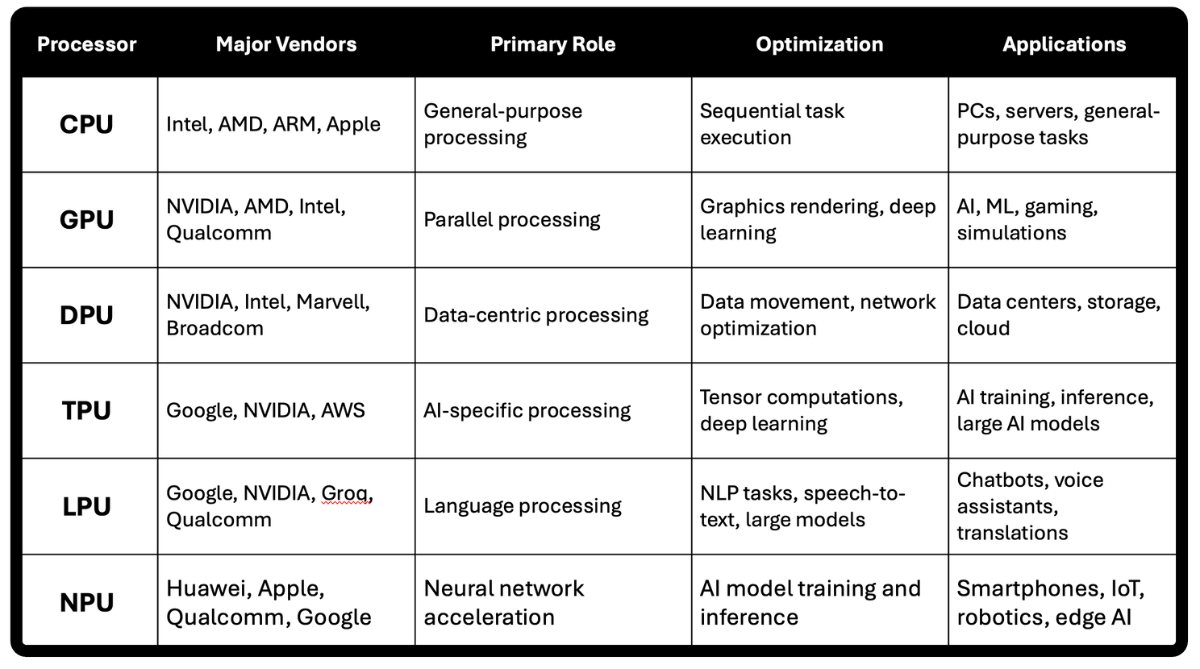
Summarized Table of Processors
Summary
Just in case you don't have a lot of time to read...
- CPU (Central Processing Unit): The general-purpose brain of a computer, handling sequential tasks like running operating systems, applications, and general computing needs.
- GPU (Graphics Processing Unit): Optimized for parallel processing, excelling in graphics rendering, machine learning, and simulations.
- DPU (Data Processing Unit): Focused on data movement, storage, and network optimization, offloading these tasks from the CPU to enhance data center efficiency.
- TPU (Tensor Processing Unit): Designed for AI-specific tasks, particularly tensor computations used in training and inference for deep learning models.
- LPU (Language Processing Unit): Specializes in natural language processing (NLP), handling tasks like text understanding, speech-to-text, and large language models.
- NPU (Neural Processing Unit): Accelerates neural network computations for AI, focusing on energy-efficient training and inference in mobile, IoT, and edge devices.
CPU: The Brain Behind Every Device
The CPU (Central Processing Unit) is the versatile core of computing, handling general-purpose tasks like operating systems, applications, word processing, and browsing, with strengths in sequential task execution and low latency. CPUs power everything from PCs and servers to mobile and embedded systems. Major vendors include Intel (Core, Xeon), AMD (Ryzen, EPYC), ARM (Cortex for energy efficiency), and Apple (M1-M3 for Macs and iPads). Intel leads the market with about 62% share, followed by AMD at 35.5%, while ARM and Apple dominate niche segments like mobile and high-efficiency devices.
GPU: The Heart of AI and Graphics Powerhouse
The Graphics Processing Unit (GPU) is the heart of artificial intelligence, driving breakthroughs in machine learning and deep learning with its unparalleled parallel processing capabilities. It excels at handling thousands of simultaneous threads, making it ideal for graphics rendering, simulations, and cryptocurrency mining. GPUs are indispensable for AI, efficiently powering massive computations like neural network training and inference. NVIDIA dominates the market (~88%) with products like GeForce for gaming and A100/H100 for AI, followed by AMD's Radeon and Instinct GPUs, Intel's Arc and integrated graphics, and Qualcomm's Adreno for mobile AR/VR. From gaming to AI innovation, GPUs are the engines of modern computing.
DPU: The Backbone of Modern Data Centers
The Data Processing Unit (DPU) specializes in handling data-intensive tasks like movement, storage, and network management, offloading these operations from the CPU to improve efficiency. With hardware accelerators for encryption and compression, DPUs are essential for SmartNICs, cloud computing, and storage infrastructure. Key players include NVIDIA's BlueField series for AI-driven data centers, Intel's Mount Evans IPUs, Marvell's OCTEON series for networking, and Broadcom's Stingray SmartNICs. The DPU market, valued at $1.6 billion in 2023, is projected to grow at a 24.5% CAGR, reaching $7.5 billion by 2031, reflecting its pivotal role in modern computing.
TPU: The AI Powerhouse for Deep Learning
The Tensor Processing Unit (TPU) is purpose-built for accelerating AI workloads, specifically designed to handle deep learning tasks like training and inference with unmatched efficiency. Optimized for tensor computations, TPUs deliver high performance in neural network processing, making them essential for large-scale AI models and applications. Leading the space, Google pioneered TPUs for its TensorFlow framework, while NVIDIA and AWS also offer TPU-like solutions tailored for AI. TPUs are widely used in AI training, autonomous systems, and large language models, driving innovation in industries from research to real-time applications. Their role cements them as a cornerstone of AI advancement.
LPU: The Engine Behind Language AI
The Language Processing Unit (LPU) is tailored for natural language processing (NLP) tasks, excelling at handling large language models, text comprehension, and speech-to-text conversions. Optimized for linguistic computations, LPUs power applications like chatbots, voice assistants, real-time translation, and sentiment analysis with high efficiency. Key players include Google, leveraging TPU advancements for NLP; NVIDIA, with GPUs optimized for AI language models; Groq, offering ultra-efficient tensor processing hardware for NLP and AI workloads; and Qualcomm, with custom silicon for mobile NLP applications. LPUs are transforming human-computer interactions, driving innovation in AI-powered language technologies.
NPU: The Accelerator of AI Intelligence
The NPU (Neural Processing Unit) is a specialized processor designed to accelerate AI and machine learning tasks, focusing on neural network training and inference. With strengths in parallelism and energy efficiency, NPUs handle complex computations like matrix multiplications, making them essential for AI workloads in smartphones, IoT devices, and robotics. Major vendors include Huawei (Kirin NPUs for mobile AI), Apple (Neural Engine in A-series and M-series chips), Qualcomm (Hexagon AI processors), and Google (AI accelerators for edge and cloud). NPUs are transforming devices by enabling real-time AI applications, from facial recognition to autonomous systems, driving innovation in edge and mobile computing.
Comparing TPUs, LPUs, and NPUs
TPUs (Tensor Processing Units), LPUs (Language Processing Units), and NPUs (Neural Processing Units) are all specialized processors designed for AI tasks but focus on different areas. TPUs excel in tensor computations, making them ideal for training and inference in large-scale neural networks across diverse AI applications. LPUs specialize in natural language processing (NLP), optimizing tasks like speech-to-text, text understanding, and large language model processing for seamless human-computer interaction. NPUs, on the other hand, are versatile accelerators for general neural network tasks, focusing on efficient AI computations in mobile, IoT, and edge devices. Together, they address unique facets of AI, from core computations to language understanding and edge intelligence.
Understanding Tensor Computations
Tensor computations are at the heart of modern AI and deep learning, involving mathematical operations on multi-dimensional arrays called tensors. These arrays store data in structures like vectors (1D), matrices (2D), or higher dimensions, enabling efficient representation and manipulation of complex datasets. Tensor computations handle tasks like matrix multiplications, dot products, and convolutions, which are critical for training and inference in neural networks. Optimized hardware, such as GPUs, TPUs, and other AI accelerators, performs these operations in parallel, significantly speeding up AI workloads like image recognition, natural language processing, and autonomous systems.
Conclusion:
Each processor type is highly specialized, addressing distinct challenges in modern computing. Understanding their differences helps in selecting the right tools for specific applications, whether it’s general-purpose tasks, AI workloads, or networking.
Originally published on LinkedIn

Mariano O'Kon speaks and advises on AI, cybersecurity, networking, infrastructure and the business impact of technology. Full bio