
The two pillars of cyber clarity
There are two types of companies: those that have been breached, and those that don’t know it yet.
Whether or not John Chambers coined that phrase, he made it famous, and it remains an uncomfortable truth. As we shift from Cloud and AI toward Quantum and Physical AI, technology grows more complex. Yet, one constant remains: Every system must be secured to achieve business outcomes.
Cybersecurity was once business critical; today, it is business defining.
The real challenge isn't just securing the organization, it’s explaining that security to the C-suite without getting lost in the "Jargon Jungle." When the conversation turns to posture, risk exposure, or threat response, alignment on budgets and expectations often breaks down.
The Paradox of Choice
At the most recent RSA Conference, the biggest event of the industry, over 650 vendors exhibited. The broader ecosystem likely exceeds 1,000 companies. From titans like Microsoft, Google, Fortinet, Cisco, Check Point and Palo Alto to highly specialized startups, the market is vast.
A decade ago, the "best of breed" strategy left mid-sized enterprises juggling 50+ tools. When things failed, teams scrambled across dozens of dashboards. When things worked, nothing happened—making it nearly impossible to demonstrate value to leadership.
How do we simplify the invisible?
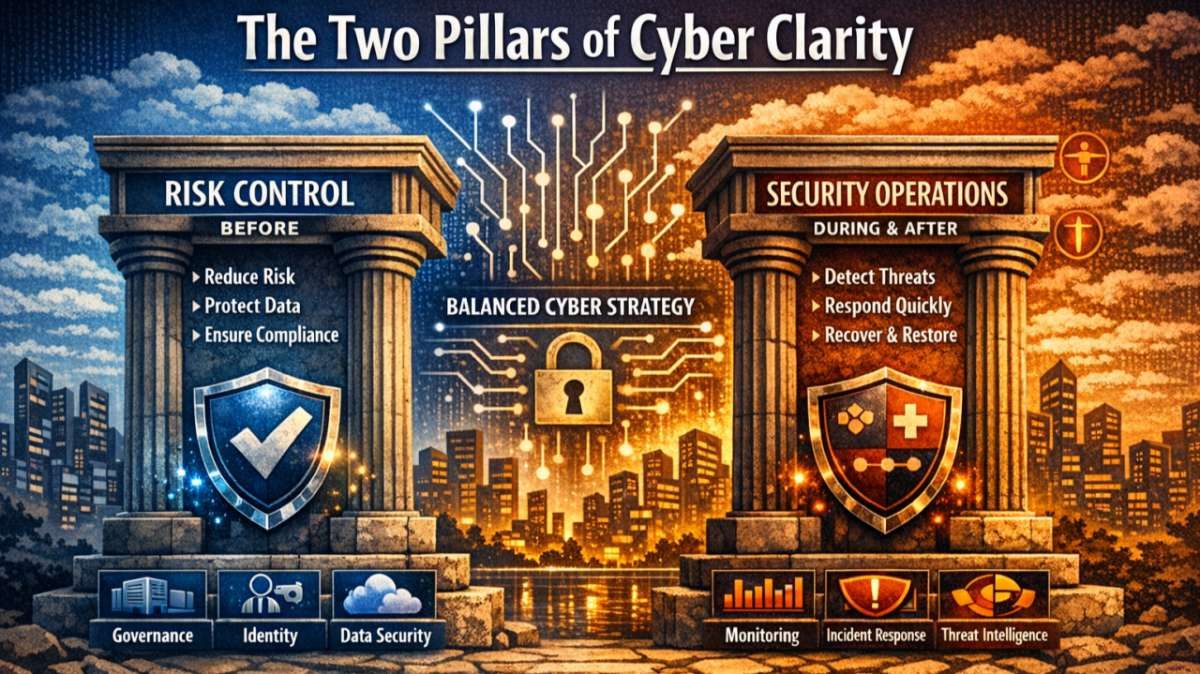
In my experience, cybersecurity complexity can be distilled into two essential pillars: Risk Control and Security Operations.
Pillar 1: Risk Control (The "Before")
Risk Control reduces the likelihood and impact of cyber events before they happen.
This pillar manages the "before". It lowers breach probability, reduces regulatory exposure, and protects the brand. It covers identity, data, applications, and cloud environments.
Risk Control answers one executive question: "Are we reducing our exposure in a measurable way?"
Pillar 2: Security Operations (The "During & After")
Security Operations detects malicious activity, coordinates response, escalates crises, restores operations, and strengthens resilience.
This pillar manages the "now". it limits downtime, protects customer trust, and ensures resilience.
Security Operations answers one executive question: “When something goes wrong, how fast and how well do we respond?”
Security Domains
Within these two pillars sit distinct security domains.
A security domain is a focused area of responsibility within the broader cybersecurity model. Each domain groups related capabilities that must be designed, implemented, and continuously operated to reduce risk and support the business.
Risk Control Domains
- Governance and Foundations
- Network and Infrastructure
- Data and Privacy
- Application and Development
- Identity and Access
- Cloud
- Third Party Risk
- Human Risk
Security Operations Domains
- Monitoring and Detection
- Security Intelligence
- Security Operations Platform
- Incident Execution
- Crisis Management
- Resilience
Navigating the Landscape
The challenge is not only understanding cyber risk. It is navigating it.
Customers must decide where to invest first. They must understand how the two pillars connect and how domains connect. They must prioritize capabilities based on risk, maturity, and business strategy.
Partners and integrators face a parallel challenge. Where should they specialize? Which capabilities should they build deeply? How do they align their services to real customer outcomes instead of selling isolated tools?
The market offers thousands of solutions, but customers don’t buy tools. They buy risk reduction and digital resilience.
What many organizations lack is a structured map to navigate this landscape. They lack a way to prioritize investment based on maturity rather than marketing hype.
Final Thought
Cybersecurity will only grow more complex. The simplest place to start is acknowledging that you must do two things simultaneously:
- Reduce the chance of a breach (Risk Control).
- Reduce the damage when one occurs (Security Operations).
These two pillars, together, form a complete cyber risk management model.
In upcoming posts, I will break down each security domain and show how to navigate today’s cybersecurity landscape with clarity and structure.
If you are wrestling with how to explain cyber risk at the executive level, I would welcome your perspective in the comments.
Originally published on LinkedIn

Mariano O'Kon speaks and advises on AI, cybersecurity, networking, infrastructure and the business impact of technology. Full bio