
The quantum deadline has entered the budget cycle
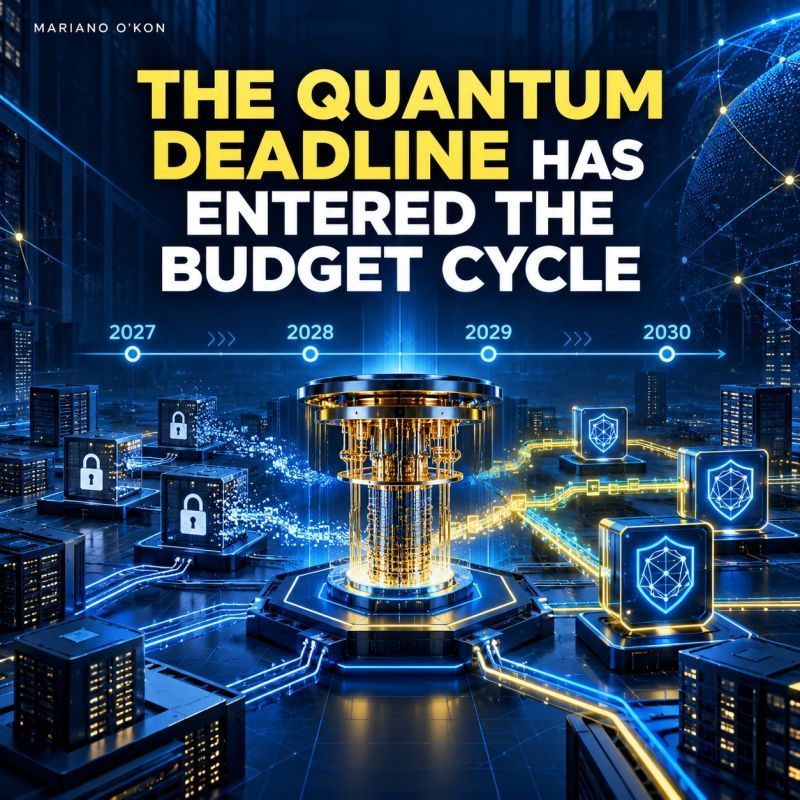
Quantum computing remains years away from breaking today’s public-key encryption at scale.
Quantum readiness has already become an infrastructure priority.
On October 1, the National Security Agency announced new post-quantum requirements for U.S. National Security Systems:
- New commercial systems must support quantum-resistant algorithms starting in 2027
- Legacy systems without quantum resilience must be phased out by 2030
The broader technology ecosystem is also moving:
- National Institute of Standards and Technology (NIST) has finalized three post-quantum cryptography standards
- Microsoft targets post-quantum protection across critical products and services by 2029
- Google Cloud begins enabling post-quantum key exchange by default this month
The urgency comes from “harvest now, decrypt later.”
Attackers collect encrypted data today, retain the information, and wait for future quantum systems to make decryption possible.
Sensitive information with a long useful life faces the greatest exposure:
- Government and defense data
- Intellectual property
- Financial records
- Healthcare information
- Digital identities and certificatesWhy this matters
Post-quantum migration involves much more than replacing an encryption algorithm.
Cryptography runs across applications, networks, cloud services, identities, APIs, certificates, hardware, and third-party platforms.
Many organizations lack a complete inventory of where encryption exists.
My takeawaythe first quantum-computing decision for most enterprises is a cybersecurity decision.
Leaders should begin with cryptographic discovery, data prioritization, vendor readiness, and crypto-agile architecture.
The quantum threat is still developing.
The migration deadline is already here.
Does your organization know which systems depend on quantum-vulnerable encryption?
Sources
- NSA, October 1, 2026: lnkd.in/eTccsWQf
- NIST, Post-Quantum Cryptography: www.nist.gov/pqc
- Microsoft, Quantum Safe Program: lnkd.in/efNmUix9
- Google Cloud, Post-Quantum TLS: lnkd.in/ecsWEZX7

Mariano O'Kon speaks and advises on AI, cybersecurity, networking, infrastructure and the business impact of technology. Full bio